The gesture · nothing but the gesture
Crafting
and ageing
Three pillars: the milk, the crafting, the ageing. At each step, the hand. No machine, no shortcut. The Maison continues what tradition has set.
The gesture · nothing but the gesture
Three pillars: the milk, the crafting, the ageing. At each step, the hand. No machine, no shortcut. The Maison continues what tradition has set.
Contents · Chapters I · II · III
A Roquefort Carles is born three times: in the meadow, under the hands, in the cave. Each passage has its own duration. The Maison shortens none of them.
Pillar I · Upstream
Milk arrives every morning, raw, from thirteen farms of the causse. All of them partners for over fifty years. Some agreements date back to François's time. Pickup happens at fixed hours, in small rounds, so the milk does not wait. It goes into the vat straight from collection, without prior heating.
Raw milk keeps the memory of its month. Spring grass, summer flowers, autumn hay: each season leaves its signature in the cheese. A non-affineur can smooth those differences by blending. Maison Carles does not. The batches remain distinct, and the cheese tells the moment when it was made.
The shepherds know their milk will go onto travets, not into an industrial vat. They also know their name stays attached to what leaves the cave. It changes the way they care for their sheep, their pastures, and the management of lactations. Nothing is written into a contract. It all holds through a continuity of attention.
First rule of the Carles process: milk that is not anonymous. Every farm is identifiable, every delivery traceable by hand. When a batch leaves, we know where its milk came from the way we know where a bottle of wine in a cellar came from.
Pillar II · The gesture
Opening · The bread
The Maison cultivates its own Penicillium roqueforti, on rye bread left in the cave month after month. The greenish mould that grows on it is the Carles strain, maintained since 1927. Each new loaf takes over from the previous one, the way a sourdough is renewed.
This ancestral method has been almost entirely replaced by industrial strains bought in vials. The Maison continues — for the continuity of taste, and for the signature it imparts to every batch.
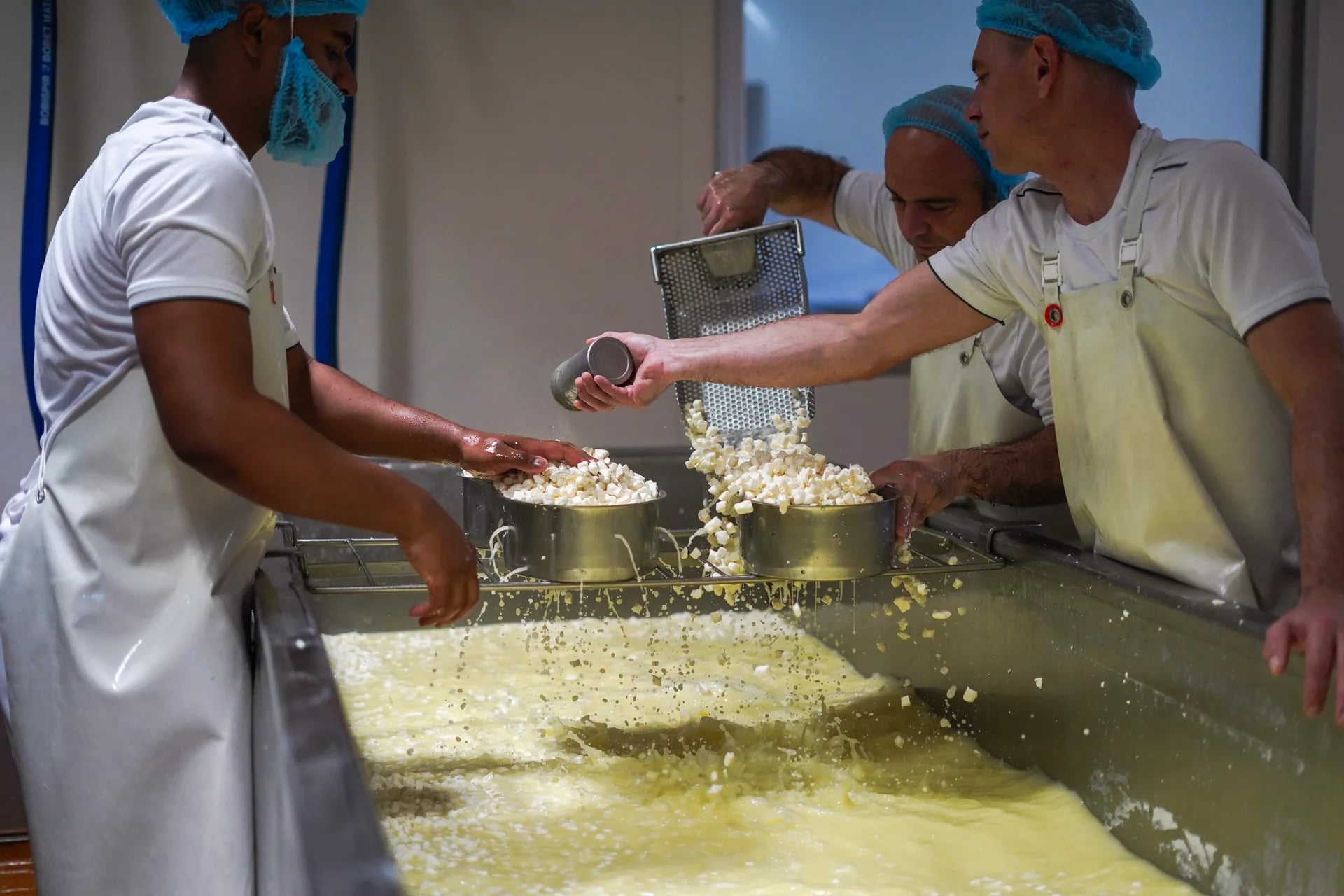
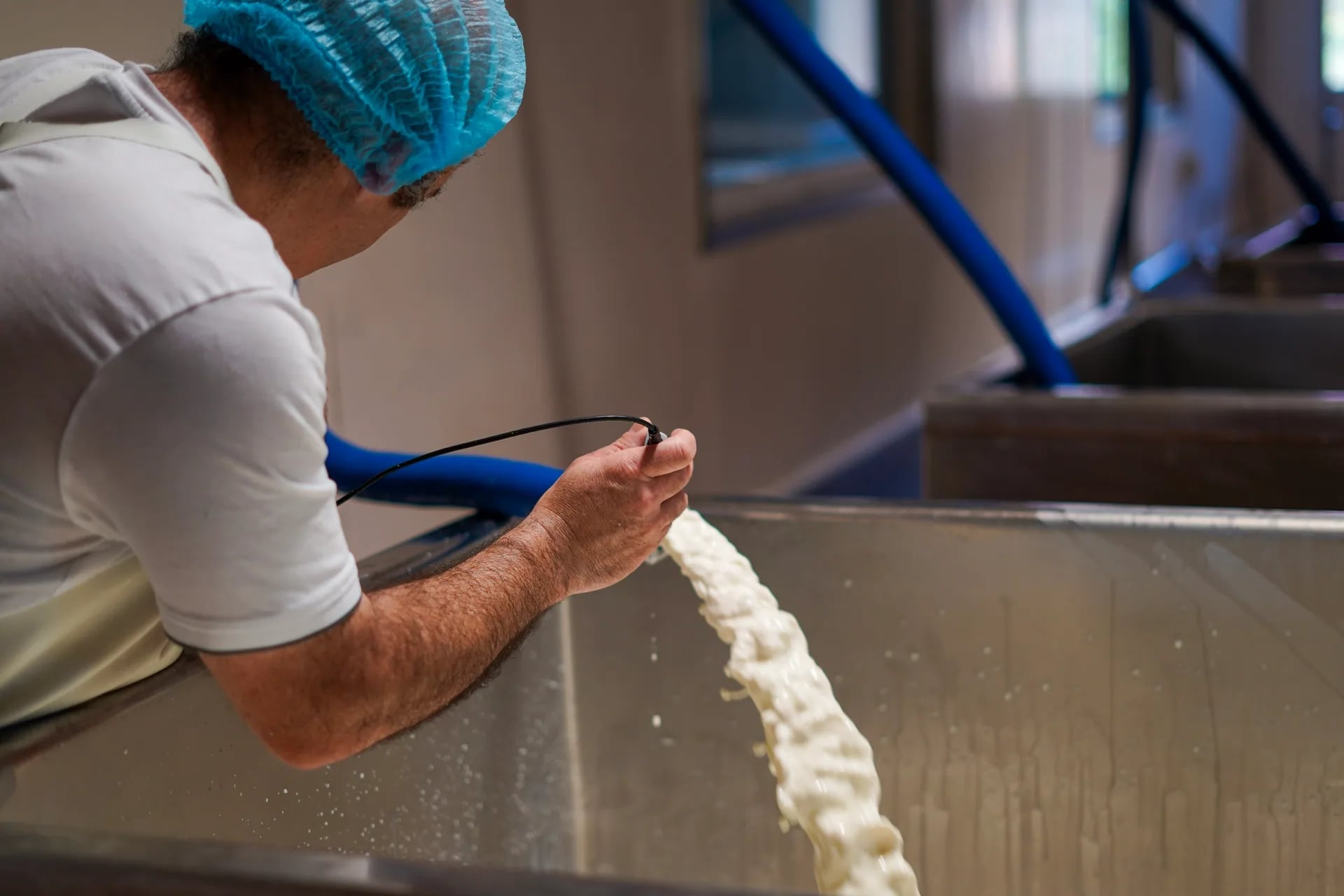
Raw milk enters the vat in the afternoon. Rennet, salt, and the house-cultivated Penicillium are added. Curdling happens slowly, over several hours, without thermal acceleration. The setting time belongs to the day's milk.
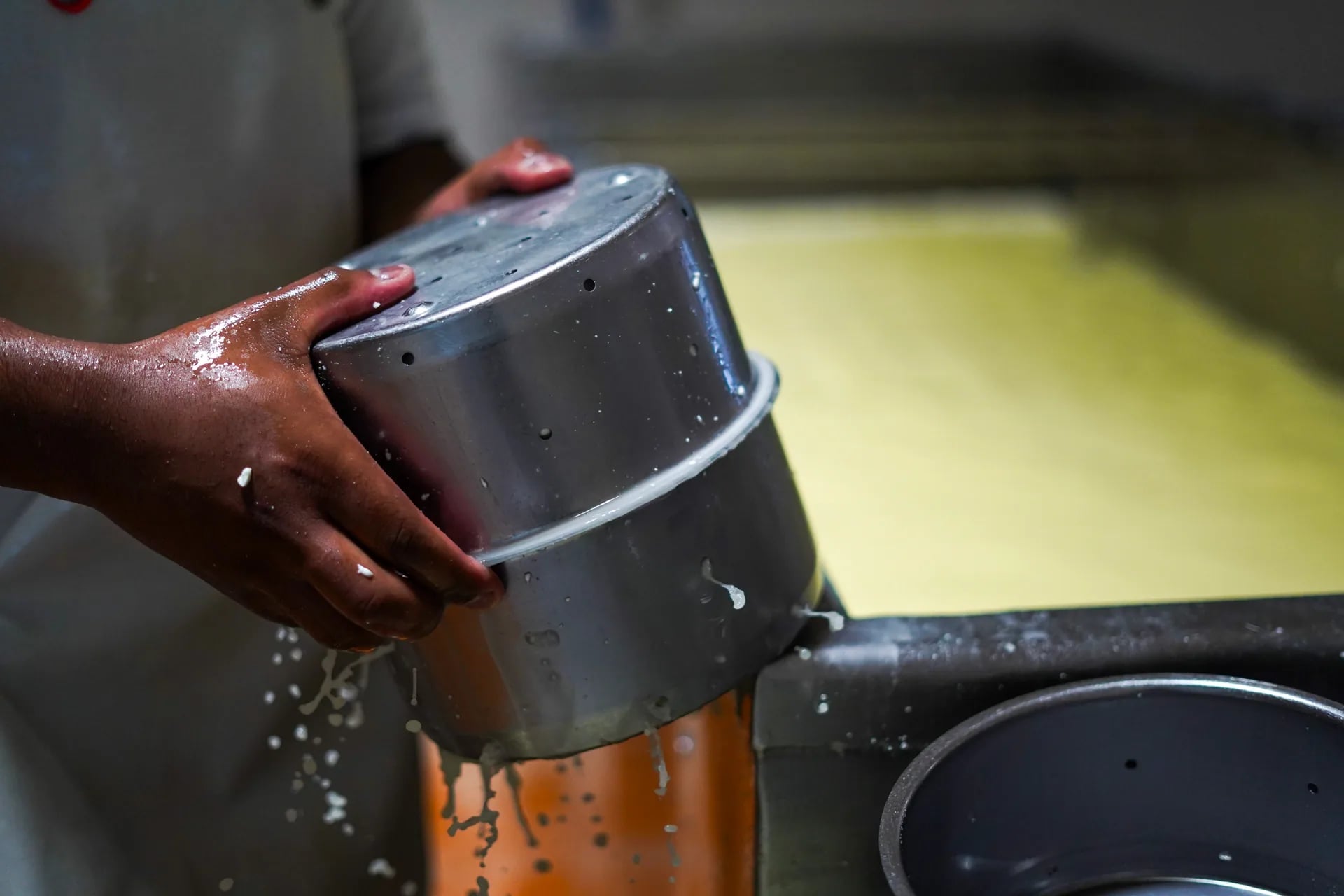
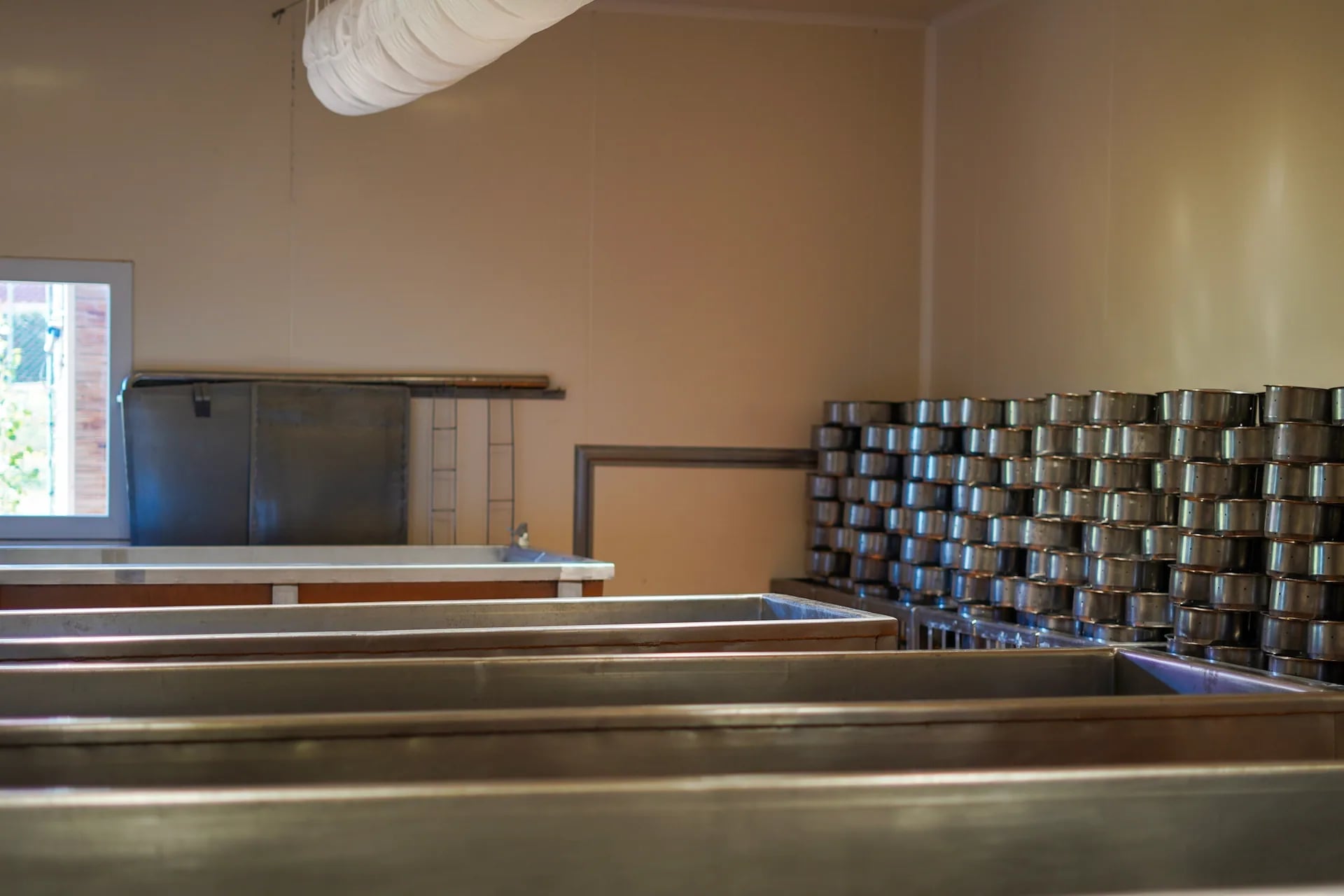
The curd is cut by hand, with a curd-knife, at the pace the paste demands. Each cheese is then placed in a mould one by one, drained without pressure, never stacked. No rotating tool replaces the hand. Every cylinder stays identifiable.
With dry salt, face by face. We rub, we wait for the salt to penetrate, we turn, we start again. The future rind takes its character here. The gesture is the same as François's; Delphine still carries it, as Jacques did before her.
A few days of pre-maturation. Each piece is watched one by one: firmness to the touch, rise of the blue, hold of the paste. Once the rind has set, the cheeses descend into the cave. They do not come back out for several months.
I am the third.
One single hand turning the cheese.
Pillar III · Time
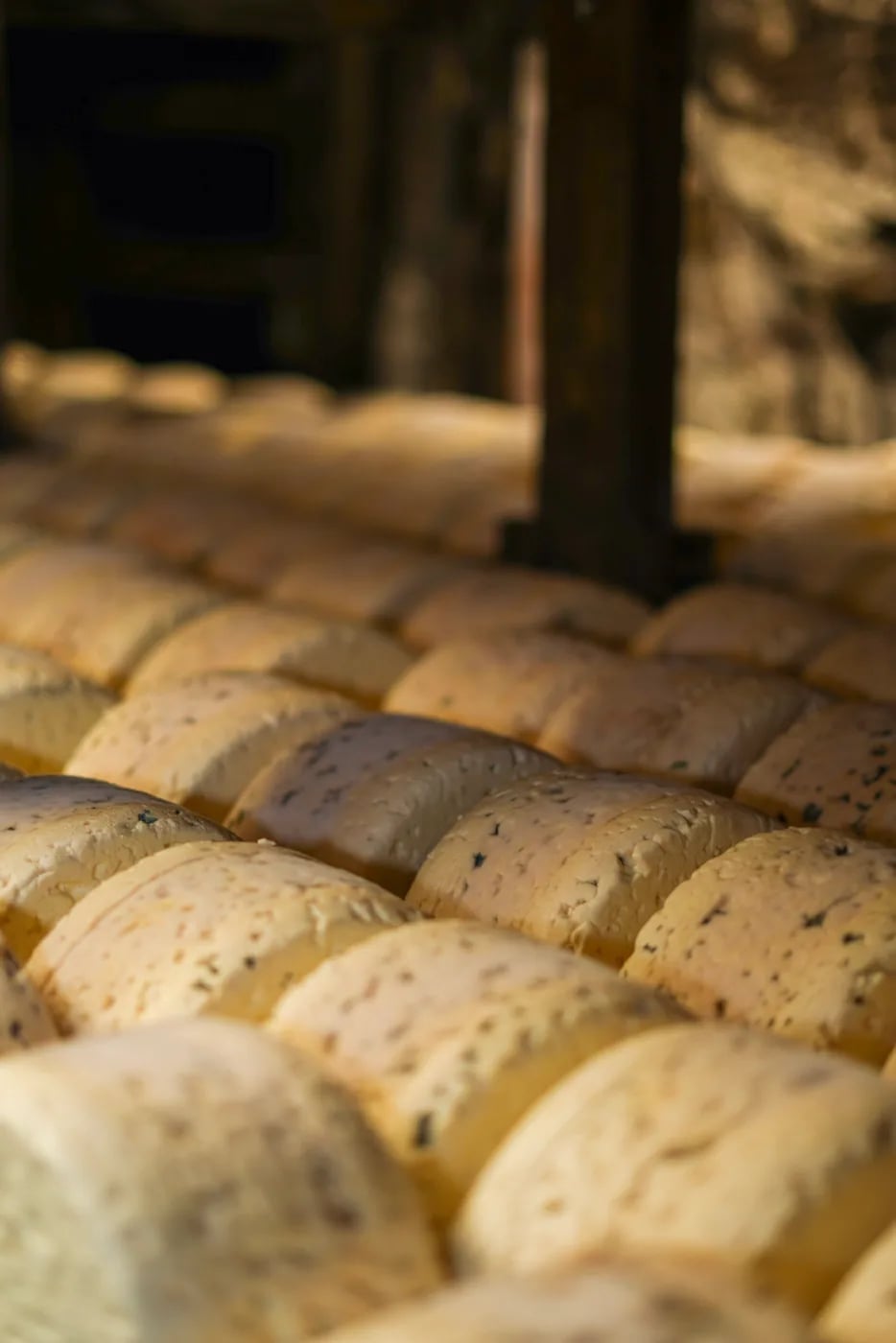
The cheeses descend into the cave. They are placed on oak travets: raw boards, nourished over the years by a microflora specific to the Maison. Each board is an ecosystem. The cheeses leave on them ferments that carry over from one batch to the next. Maison Carles is one of the last to still age on wood.
year-round
Combalou air
natural ventilation
depending on the range
Ageing lasts at least three months for AOP Roquefort. Often longer for the Convoitise, until the cheese asks to come out. Cheeses are turned regularly, by hand, moved on the boards according to their progress. No automatic schedule. Each piece is given the time it claims.
The oak travet is not an aesthetic choice. Stainless-steel boards, widely adopted by the industry, are easier to wash and quicker to maintain. They are also neutral — so they transmit nothing. Wood, on the other hand, carries a house microflora that takes part in the signature of Roquefort Carles. To remove it would be to lose part of what makes the taste.
The caves are a natural geological fault, carved millennia ago into the Combalou Rock. Fissures in the rock, the fleurines, constantly ventilate the galleries. The air that flows through comes from the mountain. It is cold, humid, regulated. The temperature holds between 7 and 10 degrees, humidity near 95%, year-round, without any human adjustment.
It is in these conditions that Roquefort invented itself, several centuries ago. No artificial cave, however efficient, exactly reproduces that blend of stability and breath. The affineurs who descend into these caves walk through a current of air that has never changed.
The cheese is watched, turned, moved. It is not rushed. When it is ready, it says so: the colour of its rind, the firmness of its paste, the spread of its blue. The affineur has been reading those signs for a lifetime. It is the last gesture of the crafting, and the longest.
The cheese tells us when it is ready.
Not the other way round.
Wood side
Raw boards, retooled each season, never washed with hot water. Between their fibres they keep the microflora left by the cheeses of the previous years. Each travet is a living heritage, passed from batch to batch.
ferment side
Stone side
A rock fissured by time, a cave that ventilates itself. Air passes through the fleurines, arriving from the mountain. Seven to ten degrees, ninety-five percent humidity, year-round. No sensor adjusts anything.
breath side
Colophon
To continue
The cheese is made. What remains is understanding it on the palate.